|
|
|
|
|
|
|
Click on the required page |
||||||
|
|
|
 Still
more reassembly (2001)) Still
more reassembly (2001)) |
|
|
After 7
years, roadworthy! |
| The Story without end .. (2) |
or, the (lengthy) restoration of my Imperial….Part 2
My first thought was to redo the brakes, next to see what wasn’t working in the steering and then to drive it a bit before restoring the chrome and upholstery. My first priority were the brake and master cylinders. While waiting for that to be finished, I examined the steering. There was a blockage on turning left whether the motor was running or not. So, on to the dismantling of the coaxial steering system, then a dry run to find out that it worked. However, as soon as the steering had to overcome any resistance, it stopped working. I suspected the front axle and suspension units might be at fault so I ordered a repair kit from Kanter. I should mention that at this time – 1995 – the car was located 15 km from my place, in an earthen-floored barn. So the work wasn’t as easy and comfortable as it might have been, what with poor lighting, forgotten tools, screws falling to the ground and disappearing, etc.
 Somehow the front
suspension was made as good as new and the new paint job was dazzling! But, there’s
no rest for the wicked, so it was back under the car to bang on what I could see of the
frame rails, but without noticeable improvement in anything. I concluded that the problem
must be located in the steering gear itself. By chance I found a replacement 1959 steering
box (constant control) which was in fine working order. It fit perfectly but the Pitman
arm was too short: it turned out that it had come from a 59 Dodge. Fortunately Hemmings
came to the rescue in the form of an ad from a fellow in California who was selling
1957-58 Imperial parts. Luckily he had a Pitman arm as well as assorted other parts. The
prices were excellent but communication was by mail and took a long time. Several weeks
later, the steering was finally working. Now it was possible at last to move the car a bit
for a photo session for Nitro magazine and later to move her to the new garage at my
place. The brakes were mounted without linings and without brake fluid because a
suspicious seepage dripping down from the half shafts was evidence of further problems
within. A compete overview of the car told me that, except for the front wheel assembly,
pretty well everything needed to be re-done. The engine, painted black, ran passably well;
the gears didn’t seem to shift properly; rust which had been invisible on first
inspection was now shown to be eating up the passenger floor pan; the convertible
top’s motor as well as the flexible piping leading to the top’s raising rams
were out of commission; the brake circuits were soldered in 10 places; the wiring loom was
the victim of large-scale home-made repairs; the vinyl on the dashboard was torn; the
chrome bezels around the instruments were pitted… The decision was obvious: a
complete body-off-frame restoration was called for.
Somehow the front
suspension was made as good as new and the new paint job was dazzling! But, there’s
no rest for the wicked, so it was back under the car to bang on what I could see of the
frame rails, but without noticeable improvement in anything. I concluded that the problem
must be located in the steering gear itself. By chance I found a replacement 1959 steering
box (constant control) which was in fine working order. It fit perfectly but the Pitman
arm was too short: it turned out that it had come from a 59 Dodge. Fortunately Hemmings
came to the rescue in the form of an ad from a fellow in California who was selling
1957-58 Imperial parts. Luckily he had a Pitman arm as well as assorted other parts. The
prices were excellent but communication was by mail and took a long time. Several weeks
later, the steering was finally working. Now it was possible at last to move the car a bit
for a photo session for Nitro magazine and later to move her to the new garage at my
place. The brakes were mounted without linings and without brake fluid because a
suspicious seepage dripping down from the half shafts was evidence of further problems
within. A compete overview of the car told me that, except for the front wheel assembly,
pretty well everything needed to be re-done. The engine, painted black, ran passably well;
the gears didn’t seem to shift properly; rust which had been invisible on first
inspection was now shown to be eating up the passenger floor pan; the convertible
top’s motor as well as the flexible piping leading to the top’s raising rams
were out of commission; the brake circuits were soldered in 10 places; the wiring loom was
the victim of large-scale home-made repairs; the vinyl on the dashboard was torn; the
chrome bezels around the instruments were pitted… The decision was obvious: a
complete body-off-frame restoration was called for.
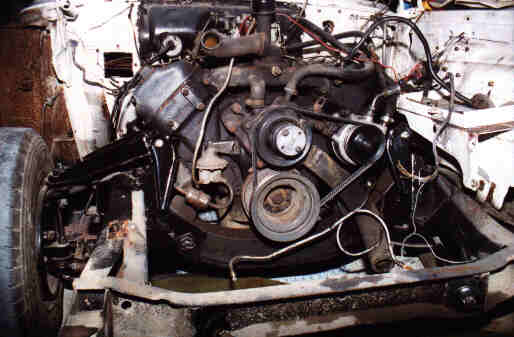 This complete
dismantling of the car stretched out over several months and gave me a chance to learn
much more than I would have from a simple shop or parts manual. The "Made in
Ghana" repairs proved, first, that Africans are past masters at on-the-spot repairs
that work and, second, that they will never be able to show a car at Pebble Beach! Here
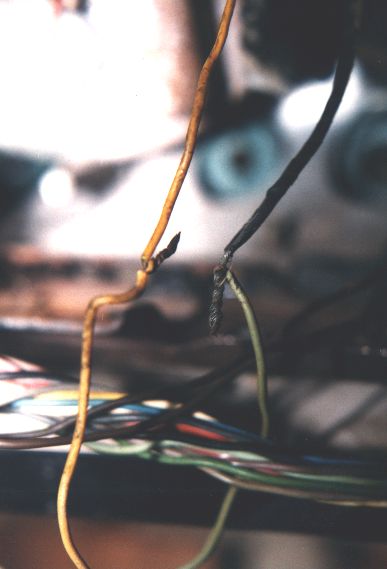
are only a few random examples: U-joints made to fit on top of the old components; a metre
of electric wire made up of four 25-centimetre sections, each in a different colour; wood
replacing the fasteners for the top (a great job but the wood had rotted); a Mercedes rim
adapted to the Imperial’s hub; and so on….
This complete
dismantling of the car stretched out over several months and gave me a chance to learn
much more than I would have from a simple shop or parts manual. The "Made in
Ghana" repairs proved, first, that Africans are past masters at on-the-spot repairs
that work and, second, that they will never be able to show a car at Pebble Beach! Here
are only a few random examples: U-joints made to fit on top of the old components; a metre
of electric wire made up of four 25-centimetre sections, each in a different colour; wood
replacing the fasteners for the top (a great job but the wood had rotted); a Mercedes rim
adapted to the Imperial’s hub; and so on….
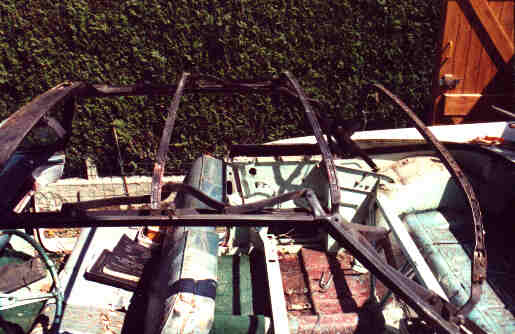
So, everything was taken apart, from the engine compartment hood
to the transmission, the upholstery, the dashboard, the rear springs…everything. Oh
yes, I forgot to tell you about how I got rid of the "African anti-rust
undercoating" apparently slapped on with a trowel in deposits up to a centimetre
thick in spots. While it had the virtue of having protected 80% of the body it refused to
yield even to sandblasting. So, it had to be removed by hand over a period of several
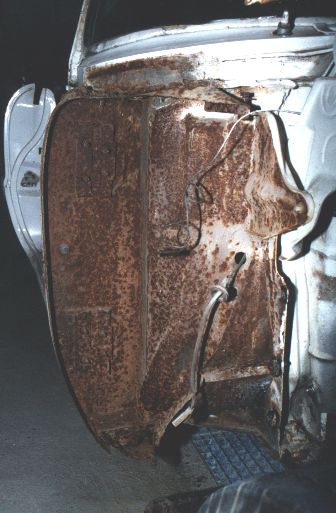
weeks, using a tool resembling a wood chisel. Then, with the dashboard removed, a sad
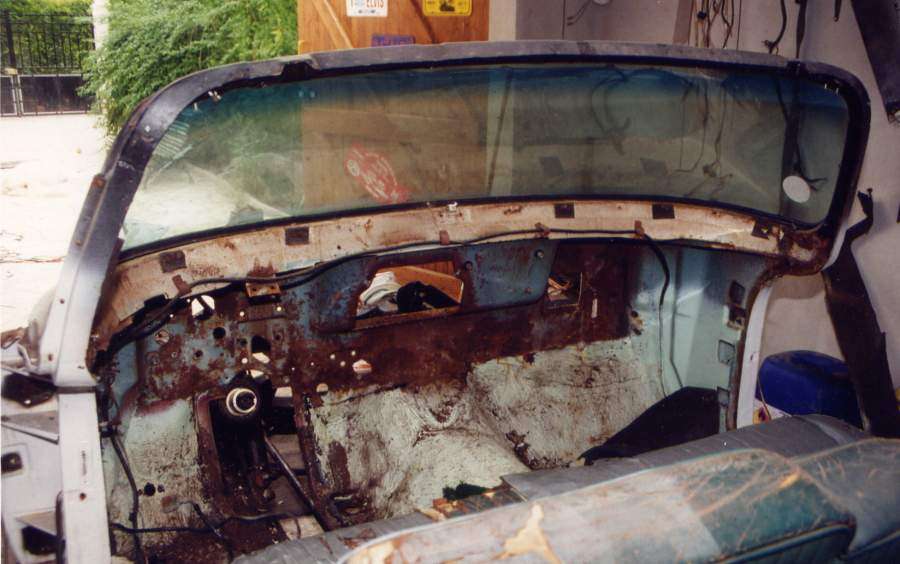
sight was revealed: rust had been at work under the insulation on the firewall and
everything had to be replaced. 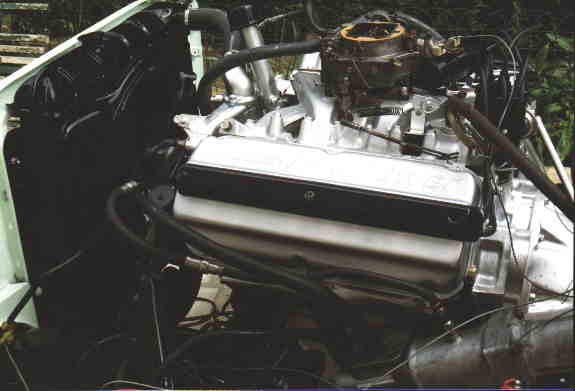 Twenty bolts
later, the body was separated from the chassis and was taken off to the sandblaster.
Sandblasting is perfect for bringing out everything that you don’t really want to
see: yes, there were great numbers of tiny holes in the trunk floor, the floor pan, and
the fenders.
Twenty bolts
later, the body was separated from the chassis and was taken off to the sandblaster.
Sandblasting is perfect for bringing out everything that you don’t really want to
see: yes, there were great numbers of tiny holes in the trunk floor, the floor pan, and
the fenders.
In the meantime other work was being done: chroming of various parts (more on that later!), removal and checking of the gauges, radio and clock; replacement of parts which were beyond repair by others taken from a donor dashboard; removal of the upholstery and sending what was left of the leather to Gary Goers; polishing of all the stainless steel trim; replating of the oxidized aluminum components, and making lists of all the things that we needed to buy. As the list grew so did both the restoration budget and the delays in getting the Crown back on the road. By a miracle, a Californian had a complete set of window glass and trim surrounds. Mine had been painted flat black and were in such poor condition that the asking price of $300 was a bargain, especially since the California glass proved to be in "as new condition" on its arrival.
Other pics (1995/96/97) (click to enlarge)
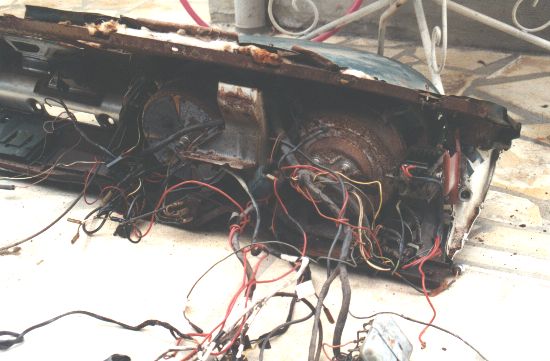
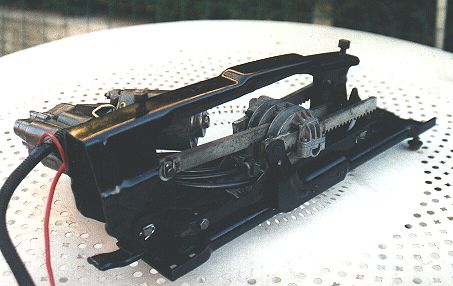
| Front fender (inner) .. | a rusty firewall.. | Rear of dashboard | Electricity made in Africa | seats track before cleaning.. | and after painting.. |
 |
 |
 |
 |
 |
 |
Thanks to "Tony" (Magister Max on the IML) for the translation ...